
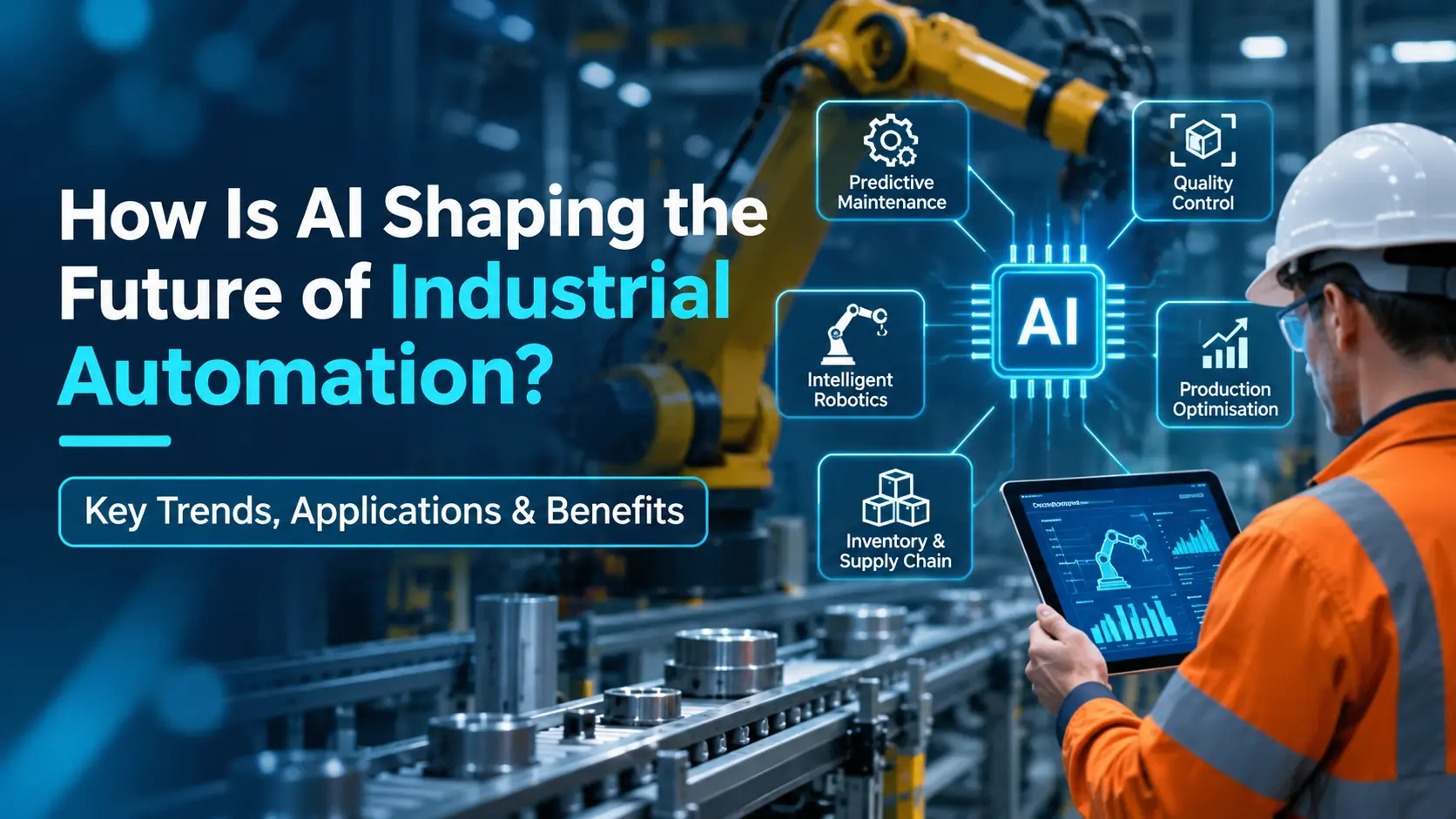
Artificial intelligence (AI) is changing how industries manage production, monitor equipment and optimize daily operations. What once depended heavily on manual supervision and predefined automation rules is gradually moving towards intelligent systems that can analyse data, identify patterns and support faster decisions. From predictive maintenance to automated quality inspection, AI is helping manufacturers improve efficiency, reduce operational delays and build more connected production environments.
For businesses, the future of industrial automation is not simply about replacing manual tasks with machines. It is about connecting equipment, software, data and business processes to create smarter operations. AI, machine learning, industrial Internet of Things (IIoT) and custom software solutions are becoming important parts of this transformation.
But how is AI shaping the future of industrial automation, and what does this mean for businesses? Let’s explore the applications, technologies, benefits and challenges driving this change.
How Is AI Shaping the Future of Industrial Automation?
AI is shaping industrial automation by enabling machines and software systems to analyse operational data, recognise patterns, predict potential problems and make informed decisions with less manual intervention.
Traditional industrial automation generally follows predefined instructions. For example, a production machine may perform the same operation whenever it receives a specific command. AI-powered automation takes this further by using data from machines, sensors and connected systems to adapt processes and improve performance.
Consider a manufacturing facility where multiple machines operate throughout the day. An AI-powered system can analyse temperature, vibration, production speed and equipment performance to identify unusual patterns. If a machine shows signs of potential failure, the system can alert maintenance teams before the problem causes an unexpected shutdown.
AI also helps businesses connect different operational systems, making it easier to monitor production, manage inventory and analyse performance from a centralised platform.
Some of the biggest changes include:
- Moving from reactive maintenance towards predictive maintenance.
- Improving product inspections through computer vision.
- Supporting intelligent robotics and automated workflows.
- Analysing production data to identify inefficiencies.
- Connecting manufacturing operations with enterprise software.
- Enabling faster and more informed operational decisions.
The result is a shift towards more intelligent, connected and data-driven industrial environments.
What Are the Key Applications of AI in Industrial Automation?
AI is being applied across different stages of industrial operations. Its role extends beyond manufacturing equipment to include quality assurance, inventory management, production planning and supply chain operations.
Here are some of the most important applications.
1. Predictive Maintenance and Equipment Monitoring
Unexpected equipment failure can interrupt production, increase maintenance expenses and affect delivery schedules. Traditional maintenance approaches often depend on fixed schedules or inspections after a problem occurs.
AI makes predictive maintenance more effective by analysing equipment data and identifying patterns associated with potential failures.
For example, sensors installed on industrial machines can collect information about temperature, vibration, pressure and operating speed. Machine learning algorithms analyse this information to detect unusual behaviour.
When the system identifies a potential issue, it can notify maintenance teams so they can investigate before the equipment fails.
Key advantages include:
- Early identification of potential equipment problems.
- Reduced unexpected production downtime.
- Better maintenance scheduling.
- Improved equipment reliability.
- More efficient use of maintenance resources.
2. AI-Powered Quality Control and Defect Detection
Product quality is essential in industries such as automotive, electronics, food processing and pharmaceuticals. Manual inspection can become challenging when production volumes increase and products require detailed quality checks.
AI-powered computer vision helps automate parts of the inspection process.
Cameras capture images of products moving along production lines, while AI models analyse them to identify visible defects, inconsistencies and quality issues.
For example, an automotive manufacturer can use computer vision to identify scratches, surface irregularities or incorrectly positioned components.
AI-based inspection systems can process large numbers of images quickly and consistently. However, their accuracy depends on the quality of training data, lighting conditions, camera placement and model performance.
Key advantages include:
- Faster product inspections.
- Consistent defect identification.
- Reduced reliance on repetitive manual checks.
- Improved quality monitoring.
- Better production quality data.
3. Intelligent Robotics and Automated Operations
Industrial robots already perform repetitive tasks such as welding, assembly, packaging and material handling. AI is making these systems more adaptable by helping them interpret information from their surroundings and respond to changing conditions.
AI-powered robotic systems can use computer vision, machine learning and sensor data to identify objects, recognise patterns and adjust certain operations.
For example, a warehouse robot can use visual recognition to identify packages and navigate around obstacles. Similarly, intelligent robotic systems in manufacturing can assist with component handling and repetitive assembly tasks.
AI can also support human-robot collaboration, where employees and robotic systems work together to complete production activities.
The objective is not necessarily to remove human involvement but to improve safety, accuracy and operational efficiency.
4. Production Planning and Workflow Optimization
Production planning involves coordinating machinery, employees, raw materials and delivery schedules. Poor planning can lead to production bottlenecks, underutilised resources and unnecessary delays.
AI can analyse historical production information, current workloads and operational requirements to help businesses improve planning.
For example, a manufacturing business can use AI to identify which production stages regularly experience delays. The system can analyse machine availability, processing times and resource requirements to highlight opportunities for improvement.
AI-powered planning tools can also help businesses evaluate different production scenarios before making operational decisions.
Common applications include:
- Production scheduling.
- Resource allocation.
- Workflow analysis.
- Bottleneck identification.
- Demand-based production planning.
5. Smart Inventory and Supply Chain Management
Managing inventory becomes more complicated when businesses deal with multiple suppliers, warehouses and changing customer demand.
AI can help improve inventory management by analysing historical sales, purchasing patterns, seasonal demand and supply chain information.
For example, an AI-based forecasting system can estimate future material requirements based on previous consumption and upcoming production schedules.
When integrated with inventory management or ERP software, these insights can help businesses make better purchasing and stock management decisions.
AI can also support supply chain monitoring by identifying unusual delivery patterns, potential shortages and changes in demand.
This helps businesses improve inventory visibility and make more informed supply chain decisions.
What AI Technologies Are Driving the Future of Industrial Automation?
Several technologies work together to make AI-powered industrial automation possible. Each plays a different role in collecting information, analysing operations and improving industrial processes.
1. Machine Learning (ML)
Machine learning allows computer systems to learn from data and identify patterns without requiring every decision to be manually programmed.
In industrial environments, machine learning can analyse production records, equipment performance and operational data to identify inefficiencies and predict potential problems.
For example, a manufacturing business can use machine learning models to analyse historical machine performance and identify conditions associated with equipment failures.
2. Computer Vision
Computer vision enables machines to interpret and analyse visual information from cameras and imaging systems.
In industrial automation, it is commonly used for:
- Product quality inspection.
- Defect detection.
- Object identification.
- Assembly verification.
- Workplace safety monitoring.
Computer vision can help manufacturers automate visual inspection processes and identify issues that may be difficult to detect consistently through manual checks.
3. Industrial Internet of Things (IIoT)
The Industrial Internet of Things connects industrial equipment, sensors and software systems so they can exchange operational information.
For example, sensors installed on manufacturing equipment can collect temperature, vibration, pressure and production data. This information can then be sent to connected applications for monitoring and analysis.
When combined with AI, IIoT provides the data foundation needed for predictive maintenance, operational monitoring and intelligent decision-making.
4. Generative AI and AI Agents
Generative AI is expanding the role of artificial intelligence beyond traditional data analysis.
Industrial businesses can use generative AI to help employees retrieve technical documentation, understand equipment information, summarise maintenance records and access operational knowledge.
AI agents can also support multi-step workflows, such as collecting information from connected business systems, identifying exceptions and preparing recommendations for human approval.
For example, a maintenance support assistant could retrieve equipment history, review previous maintenance records and help technicians identify relevant troubleshooting information.
These applications require appropriate data access controls, testing and human oversight, particularly when they interact with operational systems.
5. Digital Twins and Predictive Analytics
A digital twin is a virtual representation of a physical asset, process or system. It uses information from its real-world counterpart to help businesses understand, simulate and analyse performance.
In industrial environments, digital twins can represent individual machines, production lines or entire manufacturing processes.
When combined with AI and predictive analytics, they can help businesses:
- Simulate different production scenarios.
- Identify potential operational bottlenecks.
- Analyse equipment performance.
- Evaluate process improvements.
- Support maintenance and production planning.
Digital twins are becoming an important part of smart manufacturing because they connect physical operations with digital analysis and simulation.
How Does AI Integration Improve Industrial Automation Systems?
AI technology alone is not enough to transform industrial operations. Businesses also need the right software infrastructure to connect AI models with existing applications, databases, equipment and operational workflows.
This is where AI integration and custom software development become important.
Many manufacturing businesses already use different systems for inventory management, production planning, accounting, customer management and enterprise resource planning. When these systems operate independently, accessing complete and accurate operational information can become difficult.
Software integration helps connect these applications and create a more unified operational environment.
Here are some ways businesses can achieve this.
Connecting AI Solutions With Existing Business Applications
AI solutions can be integrated with existing applications to analyse business information and support automated workflows.
For example, an AI system connected to an inventory management platform can analyse stock levels, identify unusual consumption patterns and provide recommendations for replenishment.
Using APIs to Connect Industrial and Business Systems
Application Programming Interfaces (APIs) allow different software applications to exchange information.
For instance, an API can connect an ERP platform with a custom production management application. This allows relevant information, such as inventory levels, production schedules and order status, to move between systems.
With appropriate integrations, AI applications can access more complete operational information and provide useful insights.
Developing Custom Software for Industrial Operations
Every industrial business has different operational requirements. Standard software may not always support specialised workflows or unique reporting needs.
Custom software development allows businesses to build applications around their specific operational processes.
These applications may include:
- Centralised production monitoring dashboards.
- Automated reporting platforms.
- Inventory and resource management systems.
- Equipment performance monitoring applications.
- Custom AI-powered business workflows.
Connecting ERP Platforms With Production Processes
ERP systems help businesses manage different operational functions, including finance, inventory, procurement and resource planning.
Integrating ERP platforms with other industrial applications can improve information flow across departments.
For example, production teams can access relevant inventory information while procurement teams can use production requirements to support purchasing decisions.
For businesses looking to connect their operational systems, solutions involving custom software development, API integration and SAP services can support a more connected technology environment.
At Kryptoninc, our focus on AI automation and custom software development aligns with this software-led side of industrial transformation. Businesses can explore opportunities to connect their applications, streamline workflows and build scalable digital solutions around their operational requirements.
What Are the Benefits of AI in Industrial Automation?
AI offers several advantages when implemented alongside suitable industrial processes, reliable data and supporting software infrastructure.
The following benefits explain why businesses are exploring AI-powered industrial automation.
1. Improved Operational Efficiency
AI can analyse operational data to identify inefficient processes, recurring delays and opportunities for optimisation. This helps businesses improve workflows and make better use of available resources.
2. Reduced Equipment Downtime
Predictive maintenance systems can identify warning signs of potential equipment problems. Early alerts give maintenance teams more time to investigate and plan repairs.
3. Better Product Quality
AI-powered inspection systems can analyse products and identify visible defects during production. This helps businesses improve inspection consistency and monitor quality more effectively.
4. Lower Operational Costs
By improving resource allocation, reducing avoidable downtime and identifying process inefficiencies, AI can help businesses manage operational expenses.
However, the actual savings depend on implementation costs, data quality, system performance and the specific industrial application.
5. Faster Decision-Making
AI can process large amounts of operational information and present useful insights through dashboards, alerts and analytical reports.
This helps managers understand production performance and make more informed decisions.
6. Improved Workplace Safety
AI-based monitoring systems can help identify certain workplace safety risks, such as restricted-area access or unsafe activity around machinery.
These systems can support safety teams, although they should complement established workplace safety procedures rather than replace them.
7. Greater Scalability and Flexibility
Connected software systems and AI-powered applications can help businesses manage increasing operational complexity.
With appropriate architecture, businesses can expand their digital capabilities as production requirements and operational needs change.
What Challenges Do Businesses Face When Implementing AI in Industrial Automation?
Although AI offers significant opportunities, implementing it successfully requires careful planning. Businesses need to consider technical limitations, operational requirements and long-term maintenance before adopting new technologies.
1. Integration With Legacy Systems
Many industrial businesses operate equipment and software that were introduced years ago.
Connecting these systems with modern AI applications can be challenging because of outdated interfaces, incompatible data formats and limited integration capabilities.
Businesses may need middleware, APIs or custom software to establish reliable communication between existing and new systems.
2. Data Quality and Availability
AI systems depend on relevant and reliable data.
Incomplete equipment records, inconsistent sensor readings and disconnected databases can affect the accuracy of AI-generated insights.
Businesses should establish appropriate data collection, storage, validation and management processes before deploying AI solutions.
3. Initial Implementation Costs
AI implementation can involve expenses related to software development, infrastructure, sensors, integration, employee training and ongoing maintenance.
Instead of automating everything at once, businesses can start with a specific operational problem and evaluate the results before expanding.
4. Cybersecurity and Data Protection
Connecting industrial equipment and business applications creates additional digital access points that need protection.
Businesses should consider access controls, network segmentation, secure APIs, monitoring and regular security assessments.
Security is particularly important when AI applications interact with systems that support critical industrial operations.
5. Skills Gaps and Employee Training
Implementing AI requires a combination of technical knowledge, operational understanding and data management skills.
Employees may need training to understand AI-generated recommendations, work with new applications and identify when human intervention is necessary.
6. Ongoing Monitoring and Maintenance
AI models and software applications need continuous monitoring to ensure they remain accurate and reliable.
Changes in production conditions, equipment behaviour or data patterns can affect model performance over time.
Businesses should establish processes for evaluating results, updating models and maintaining connected applications.
The National Institute of Standards and Technology’s 2026 smart manufacturing roadmap also highlights data management, system integration, reliability and trustworthy AI as important considerations for industrial adoption.
What Does the Future of AI in Industrial Automation Look Like?
The future of industrial automation will involve closer connections between physical equipment, intelligent software and business applications.
AI is expected to play a larger role in helping manufacturers move from isolated automated processes towards more connected and adaptive operations.
Here are some developments shaping this direction.
1. Growth of Intelligent and Connected Factories
Smart factories will increasingly use connected equipment, sensors, software applications and AI systems to monitor production activities.
This will allow businesses to gain better visibility into operations and respond more effectively to changing production requirements.
2. Greater Adoption of Autonomous Systems
AI-powered robotics and autonomous equipment are expected to support more complex industrial tasks.
These systems will increasingly combine visual recognition, sensor information and intelligent decision-making to perform specific activities with less manual intervention.
3. More Advanced Predictive Maintenance
As businesses collect more equipment performance data, predictive maintenance systems can become more useful for identifying potential operational issues.
AI models will continue to support maintenance planning, equipment monitoring and operational reliability.
4. Greater Integration Between AI, ERP and Industrial Software
AI will increasingly become part of the wider business software environment.
Connecting AI applications with ERP platforms, inventory systems and production management software can help businesses use operational information more effectively.
This creates opportunities for custom software development and API integration.
5. Real-Time Intelligence Through Edge AI
Edge AI allows certain AI processing tasks to happen closer to where data is generated, such as on industrial devices or local computing infrastructure.
This can reduce the need to send every piece of information to a central cloud platform and may help applications respond faster.
6. More Sustainable Manufacturing Operations
AI can help businesses analyse energy consumption, identify resource inefficiencies and improve production planning.
Over time, these capabilities may support more efficient resource utilisation and reduce unnecessary operational waste.
The direction of industrial AI is increasingly focused not only on productivity but also on resilience, safety and sustainability.
How Can Businesses Prepare for AI-Driven Industrial Automation?
Businesses do not need to transform their entire industrial infrastructure overnight. A structured approach can help them identify practical opportunities and adopt AI at a manageable pace.
Here are some steps to consider.
1. Identify processes suitable for AI automation
Start by reviewing repetitive, data-intensive or time-consuming processes. Identify where AI could improve monitoring, forecasting, quality inspection or workflow management.
2. Evaluate existing software and infrastructure
Review current applications, databases, equipment connectivity and data collection processes. Identify integration limitations before selecting an AI solution.
3. Start with smaller AI projects
Choose a specific business problem, such as maintenance monitoring or automated reporting. A smaller implementation makes it easier to evaluate performance and understand the potential return on investment.
4. Invest in data infrastructure
Establish reliable processes for collecting, storing and managing operational data. AI applications need relevant information to produce useful results.
5. Focus on software integration
Ensure new AI applications can communicate with relevant business systems. API development, custom software and ERP integration can help connect different parts of the technology environment.
6. Measure performance and improve continuously
Track relevant metrics such as equipment downtime, production efficiency, defect rates and operational costs. Use these measurements to evaluate whether the AI implementation is delivering meaningful improvements.
Conclusion: Building the Future of Industrial Automation With AI
AI is changing industrial automation by making manufacturing processes more intelligent, connected and data-driven. From predictive maintenance and automated quality inspection to intelligent robotics and production optimisation, AI is creating new opportunities for businesses to improve operational performance.
However, successful AI adoption involves more than implementing individual tools. Businesses also need reliable data infrastructure, compatible software applications and effective integration between existing systems.
As industrial operations become increasingly connected, custom software development, API integration and AI-powered applications will play an important role in supporting digital transformation.
For businesses looking to modernise their operations, Kryptoninc provides expertise in AI automation, custom software development and enterprise technology solutions. The right software strategy can help organisations streamline workflows, connect business applications and prepare their operations for an increasingly intelligent future.
Explore how Kryptoninc can support your business with its AI automation and software development services