
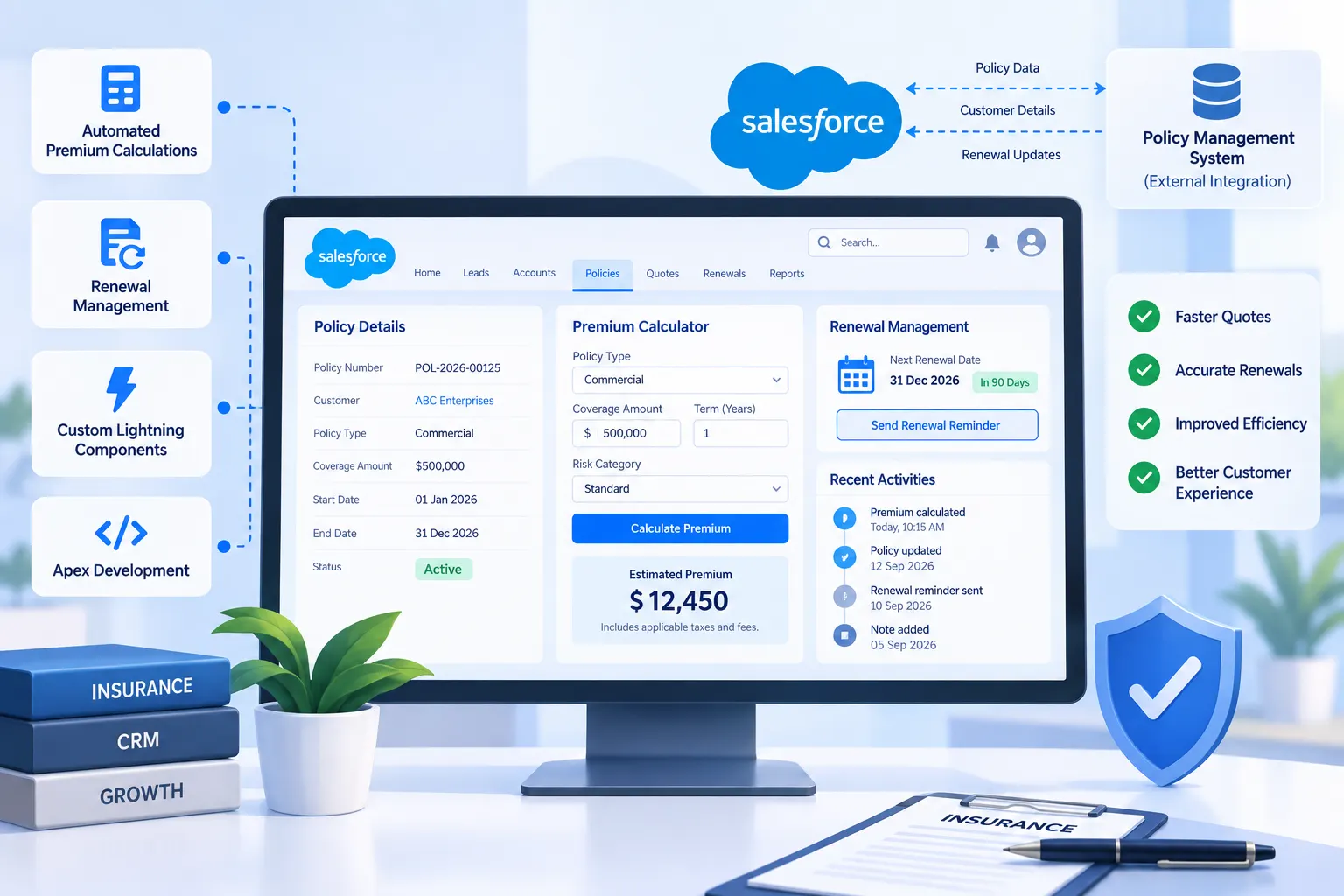
The CRM held customer records, but the real work still happened outside it:
They already had Salesforce CRM management handled for basic customer records, this wasn’t a greenfield implementation. What they actually needed was someone to automate the insurance-specific work that had been sitting outside the system the whole time.
Since the core CRM structure was already reasonably solid, this project leaned heavily on Apex development rather than a full rebuild. We started by sitting down with the senior agent whose head held most of the renewal-calculation logic, to get all of it written down properly before building anything on top of it.
From there:
The premium calculation logic turned out to be more involved than we’d scoped for going in. A few policy types had pricing exceptions that weren’t documented anywhere, they existed purely because one agent had been calculating them a certain way for years. We had to go back and forth with the team a few times to catch all of these before the automated calculation actually matched what agents were doing by hand.
Agents can now quote a renewal premium during the call instead of promising to follow up later. Renewal reminders now go out automatically, and the client reported zero missed renewal notifications in the first quarter after go-live, compared to a handful of lapsed policies the quarter before that. With customer and policy data now syncing between systems, agents stopped needing to check two separate screens for basic account information.
One thing still being refined: a couple of niche policy types with unusual pricing history are still flagged for manual review rather than fully automated, since the team wasn’t confident enough yet to let an auto-calculated quote go out on those cases untouched.
Frontend: ReactJs
Backend: NodeJs
Mobile: Flutter
Database: MongoDB & Redis
Cloud/Hosting: AWS
Other Tools/Integrations: Flolive