
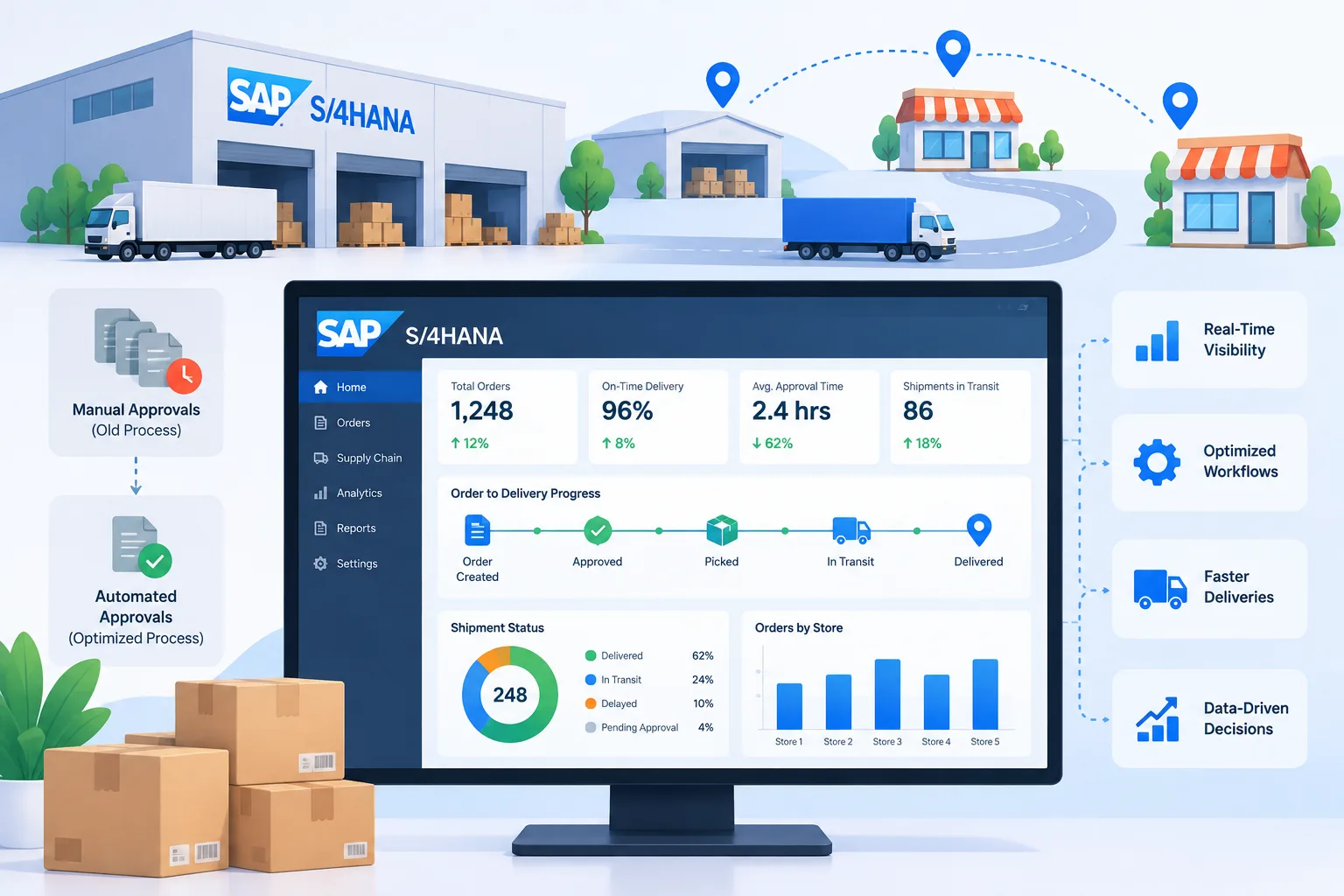
The S/4HANA migration had fixed the infrastructure side, but it surfaced a separate problem that had been sitting underneath it the whole time:
They didn’t need new infrastructure this time. They needed someone to actually look at the process itself, since the system could clearly move faster than the workflow on top of it was allowing.
Before touching any configuration, we spent time tracing shipments end to end, pulling timestamps from the system for a sample of transfers over a few weeks to see where time was genuinely being lost, rather than going off assumptions.
That process optimization exercise turned up something the client hadn’t expected: the second approval stage, meant to be a final check, was approving almost everything without any real review. It had become a rubber stamp that added delay without adding much value.
Based on that, we:
Rolling back the approval step took some convincing internally, a couple of managers were understandably nervous about removing a control, even one that wasn’t doing much. We handled that by keeping a threshold-based exception in place, so anything genuinely high-value still went through review, and by running the old and new process in parallel for a few weeks so they could see the data before fully committing to the change.
Average transfer time from warehouse to store dropped by close to 40%, mostly from eliminating the redundant approval stage. Stockouts tied to delayed transfers dropped by roughly 25% in the months following rollout, since fast-moving items no longer sat waiting on a sign-off that rarely changed anything. The logistics team also got a clear, data-backed view of delivery costs for the first time, which they’ve since used to renegotiate terms with a couple of regional transport vendors.
One thing still under review: the value threshold for requiring manual approval was set conservatively at rollout, and the team is now looking at whether it can be raised further, given how few exceptions have actually needed manual sign-off so far.
Frontend: ReactJs
Backend: NodeJs
Mobile: Flutter
Database: MongoDB & Redis
Cloud/Hosting: AWS
Other Tools/Integrations: Flolive