
Customer expectations are changing rapidly. People want quick responses, accurate information and support whenever they need it. However, managing customer enquiries manually can become challenging as a business grows. Long response times, repetitive questions and increasing support workloads can affect customer satisfaction and operational efficiency.
This is where AI customer service automation becomes valuable. It allows businesses to use artificial intelligence to understand customer questions, provide relevant answers, manage support requests and automate repetitive customer service tasks.
Unlike traditional customer support systems that depend entirely on predefined responses, modern AI-powered solutions can understand natural language, identify customer intent and generate relevant responses based on business information.
For Australian businesses looking to improve their customer experience, AI customer service automation offers an opportunity to provide faster support while reducing manual workloads.
In this guide, we will explain how AI customer service automation works, its key technologies, business benefits, practical applications and how companies can implement the right solution.
What Is AI Customer Service Automation?
AI customer service automation is the use of artificial intelligence technologies to manage and improve customer support interactions with minimal manual involvement.
It combines technologies such as machine learning (ML), natural language processing (NLP), large language models (LLMs) and workflow automation to understand customer enquiries and perform relevant support activities.
For example, when a customer visits a website and asks about product pricing, an AI-powered customer service assistant can understand the question, retrieve the relevant information and provide an immediate response.
Depending on its integrations and permissions, the system can also perform additional tasks, such as:
- Answering frequently asked questions.
- Checking order or service information.
- Collecting customer details.
- Creating and updating support tickets.
- Scheduling appointments.
- Sending automated email notifications.
- Transferring complex enquiries to human support agents.
The main purpose of AI customer service automation is not to eliminate human support teams. Instead, it helps businesses manage repetitive enquiries more efficiently so employees can focus on complex customer requirements.
How Does AI Customer Service Automation Work?
AI customer service automation works through a series of connected processes. It receives a customer enquiry, understands the request, finds relevant information and generates an appropriate response or performs an action.
Here is how the process generally works.
1. Customer Sends an Enquiry
The process begins when a customer contacts a business through an available communication channel.
These channels may include:
- Website live chat.
- Email.
- WhatsApp.
- Social media messaging.
- Mobile applications.
- Automated voice assistants.
For example, a customer visiting an Australian company’s website might ask, “Do you provide installation services in Melbourne?”
The AI assistant receives the message and begins analysing the customer’s request.
With AI customer service automation, businesses can manage enquiries from multiple channels through a connected support system rather than handling every interaction separately.
2. AI Understands Customer Intent
After receiving the enquiry, the AI system analyses the message to understand what the customer actually wants.
This process uses Natural Language Processing (NLP) and machine learning to interpret everyday language, identify important information and recognise the customer’s intent.
For example, these questions have a similar meaning:
- How much does your service cost?
- Can you share your pricing?
- What are your service charges?
A traditional chatbot might require customers to select predefined options. However, an AI-powered system can recognise that all three questions relate to pricing.
This makes AI customer service automation more flexible because customers can communicate naturally instead of following rigid conversation flows.
3. AI Retrieves Relevant Business Information
Once the system understands the enquiry, it needs accurate information to generate a useful response.
An AI assistant can connect with business knowledge bases, FAQs, CRM platforms, product databases and other approved information sources.
For example, if a customer asks about a company’s refund policy, the AI assistant can retrieve the relevant policy information and explain it in a conversational format.
Depending on the system configuration, it may also access:
- Customer account information.
- Product and service details.
- Order management systems.
- Appointment schedules.
- Previous support conversations.
- Internal documentation.
This step is important because AI customer service automation should provide answers based on verified business information rather than making assumptions.
4. AI Generates a Relevant Response
After retrieving the required information, the AI system generates a response that addresses the customer’s question.
Modern AI solutions use large language models (LLMs) to understand context and create natural-sounding responses.
For example, if a customer asks whether a company offers emergency technical support, the AI assistant can check the available service information and explain the support options.
Businesses can also configure responses according to their brand voice, communication guidelines and customer service policies.
This helps create more consistent customer interactions across different communication channels.
5. AI Performs Automated Actions
Modern AI customer service automation goes beyond answering questions.
When connected with business applications and workflow automation tools, an AI assistant can perform specific actions on behalf of the customer.
For example:
- Create a new customer support ticket.
- Update customer records in a CRM.
- Schedule a consultation.
- Send an appointment confirmation.
- Notify the relevant support department.
- Trigger an automated follow-up email.
Consider a customer who wants to book a consultation. The AI assistant can collect the required details, check an integrated appointment calendar and initiate the booking process.
These capabilities depend on the integrations, access permissions and workflows configured for the business.
6. Complex Enquiries Are Transferred to Human Agents
Not every customer enquiry should be handled automatically.
Some requests involve sensitive information, complicated technical problems, complaints or decisions that require human judgement.
In these situations, the AI system can transfer the conversation to an appropriate support representative.
It can also provide a conversation summary, customer details and the steps already completed.
This reduces the need for customers to explain their problems repeatedly.
A well-designed AI customer service automation system combines automated assistance with human support to deliver a more effective customer experience.
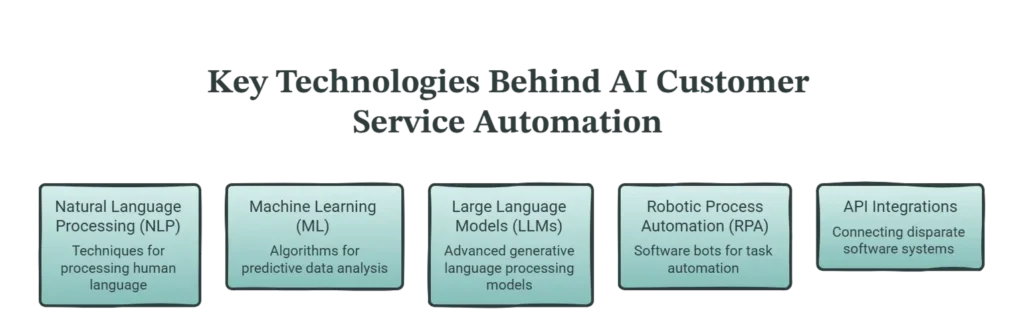
Key Technologies Behind AI Customer Service Automation
Several technologies work together to make intelligent customer support possible.
Natural Language Processing (NLP)
NLP allows AI systems to understand and interpret human language. It helps identify customer intent, recognise important information and understand different ways of asking the same question.
Machine Learning (ML)
Machine learning helps AI systems identify patterns in data and improve their performance over time. It can support intent classification, customer query analysis and response recommendations.
Large Language Models (LLMs)
LLMs help generate conversational responses based on customer questions and available business information. They make AI assistants more capable of handling complex conversations.
Robotic Process Automation (RPA)
RPA automates repetitive, rule-based tasks such as transferring information between applications, updating records and processing routine requests.
API Integrations
APIs allow different software applications to communicate with each other. They enable AI customer service automation to connect with CRM platforms, databases, booking systems and other business tools.
When these technologies work together, businesses can build customer support systems that understand enquiries and complete useful tasks.
Benefits of AI Customer Service Automation for Businesses
Implementing AI customer service automation can improve several areas of business operations.
1. Provide 24/7 Customer Support
Customers may visit a website or send an enquiry outside normal business hours.
An AI-powered assistant can handle common questions and provide relevant information even when the support team is unavailable.
This allows businesses to maintain customer communication without requiring employees to remain available around the clock.
2. Reduce Customer Response Times
Manual customer support can create delays, particularly when businesses receive a high volume of enquiries.
AI customer service automation can respond to common questions immediately and direct more complicated requests to the appropriate team.
Faster responses help customers find information without waiting for an available representative.
3. Reduce Repetitive Workloads
Customer service employees often spend significant time answering similar questions, collecting customer information and updating support records.
Automating these activities allows employees to concentrate on tasks that require problem-solving, personal attention and decision-making.
4. Improve Customer Experience
Customers appreciate receiving clear and relevant information without unnecessary delays.
AI assistants can provide consistent responses, guide customers through common processes and help them find the information they need.
When implemented correctly, AI customer service automation can make customer interactions more convenient.
5. Support Business Growth
As businesses expand, customer enquiries often increase.
Hiring additional support employees may not always be the most practical way to manage every repetitive task.
AI customer service automation solutions can help businesses handle larger enquiry volumes by automating suitable processes and allowing human teams to focus on higher-value activities.
6. Improve Customer Service Insights
AI-powered support systems can analyse customer interactions and identify frequently asked questions, common complaints and recurring service issues.
Businesses can use these insights to improve their FAQs, update service processes and identify areas where customers need additional assistance.
Practical Examples of AI Customer Service Automation
AI customer support can be applied across different industries and business operations.
Here are some practical examples.
E-commerce Businesses
Online retailers receive regular questions about product availability, delivery schedules, returns and refunds.
AI customer service automation can help customers find product information, check order details and understand return procedures.
Healthcare Businesses
Healthcare providers can use AI assistants to answer general service questions, explain appointment procedures and help patients navigate booking processes.
However, sensitive medical enquiries and clinical decisions should be handled through appropriate qualified professionals and secure systems.
Real Estate Businesses
Real estate agencies receive enquiries about property availability, inspections, rental information and purchasing procedures.
An AI assistant can collect prospective buyer or tenant details, provide approved property information and help arrange inspection appointments.
IT and Technology Companies
IT businesses can use AI customer service automation to answer common technical questions, collect troubleshooting details and create support tickets.
For more complicated technical problems, the system can transfer the enquiry to the relevant technical team with the necessary context.
Professional Service Businesses
Accounting, consulting and other professional service providers can use AI assistants to answer general service questions, collect enquiry details and schedule initial consultations.
This helps businesses manage incoming enquiries while keeping employees focused on delivering professional services.
How to Implement AI Customer Service Automation in Your Business
Successful implementation requires more than simply adding a chatbot to a website. Businesses should identify their requirements and choose automation processes that provide practical value.
Consider the following steps.
1. Identify Repetitive Customer Enquiries
Start by reviewing the questions your customer service team receives most frequently.
Identify tasks such as answering FAQs, checking service availability, collecting contact information and sending appointment confirmations.
These are generally suitable starting points for automation.
2. Choose the Right AI Solution
Select an AI platform based on your business requirements, communication channels and existing software.
Consider whether you need a website chatbot, AI voice assistant, automated email support or a more comprehensive customer service automation system.
3. Connect Existing Business Applications
Your AI solution should work with the systems your business already uses.
Depending on your requirements, integrations may include CRM platforms, customer databases, booking software, email applications and support ticketing systems.
4. Train and Configure the AI Assistant
Provide the AI assistant with accurate business information, FAQs, service documentation and communication guidelines.
Define what the system can answer, which actions it can perform and when it should transfer an enquiry to a human employee.
5. Test the Automation Workflow
Before launching the solution, test different customer questions and scenarios.
Check whether the AI understands enquiries correctly, retrieves accurate information and performs the intended actions.
Also test situations where the AI should escalate an enquiry rather than generate an unsupported answer.
6. Monitor and Improve Performance
After implementation, regularly review customer conversations, response accuracy, escalation rates and customer feedback.
Use this information to update knowledge sources, improve workflows and identify additional automation opportunities.
Choosing AI Customer Service Automation Solutions in Australia
Australian businesses have different customer support requirements depending on their industry, business size and operational structure.
Some companies may only need an AI chatbot to answer common website enquiries, while others may require integrated automation across CRM platforms, email systems, booking software and customer databases.
When evaluating AI customer service automation solutions, consider the following factors:
- Integration capabilities: Can the solution connect with your existing business applications?
- Scalability: Can it manage increasing customer enquiries as your business grows?
- Data security: Does it provide suitable access controls and data protection?
- Customisation: Can responses and workflows be configured according to your business requirements?
- Human support: Can complicated enquiries be transferred to the appropriate employees?
- Performance monitoring: Can you measure response accuracy and customer satisfaction?
Businesses looking for AI automation services in Melbourne or AI automation services in Brisbane should also consider providers that can understand their existing workflows and develop solutions around specific operational requirements.
Rather than choosing a solution based only on its features, focus on how effectively it addresses your actual customer service challenges.
How Kryptoninc Helps Businesses With AI Automation Services
Implementing AI customer service automation requires the right combination of AI technologies, system integrations and workflow design.
Kryptoninc provides AI integration and automation services to help businesses connect intelligent technologies with existing applications and streamline repetitive business processes.
Its automation capabilities include customer support automation, lead management automation, workflow automation and AI-powered business process automation.
Businesses can explore Kryptoninc’s AI Automation Services to understand how AI integration can support their operational requirements.
Whether a business is exploring AI automation services in Melbourne or AI automation services in Brisbane, the right implementation approach should begin with identifying repetitive tasks, understanding existing systems and selecting suitable automation opportunities.
With a properly designed solution, businesses can improve customer communication, reduce manual workloads and build more efficient support processes.
Final Thoughts
AI customer service automation is changing how businesses manage customer interactions. By combining natural language processing, machine learning, large language models and workflow automation, companies can provide faster responses and streamline repetitive support activities.
From answering common questions to managing support tickets and scheduling appointments, AI-powered systems can support different stages of the customer service process.
However, successful implementation depends on selecting the right technologies, integrating existing business applications and maintaining appropriate human oversight.
For businesses looking to improve customer support and streamline operations, exploring AI customer service automation solutions can be a practical step towards building more efficient and responsive business processes.